Introduction
Automation has moved far beyond simple scripts and repetitive tasks. Businesses today can automate everything from data entry and invoice processing to customer support, document analysis, research, and multi-step business workflows.
Two technologies often appear in these conversations: Robotic Process Automation (RPA) and AI agents.
At first glance, they may seem similar. Both can interact with business applications, reduce manual work, and complete tasks with limited human intervention. But the way they approach automation is fundamentally different.
RPA is designed to follow predefined instructions. It works best when a process is predictable, structured, and governed by clear rules.
AI agents are designed to work toward a goal. They can interpret information, reason about what needs to happen, choose actions, use tools, and adapt when the situation changes.
That difference is important.
An RPA bot might be told exactly which application to open, which fields to read, and where to enter the information. An AI agent might instead receive a goal such as, "Review these customer requests, determine which ones require escalation, gather the relevant information, and prepare the appropriate next steps."
The two technologies therefore solve different types of problems. RPA prioritizes consistency and deterministic execution, while AI agents introduce adaptability and decision-making into automation.
The real question is not whether AI agents will replace RPA. In many business environments, the more useful question is:
Where should you use RPA, where should you use AI agents, and where should they work together?
What Is RPA?
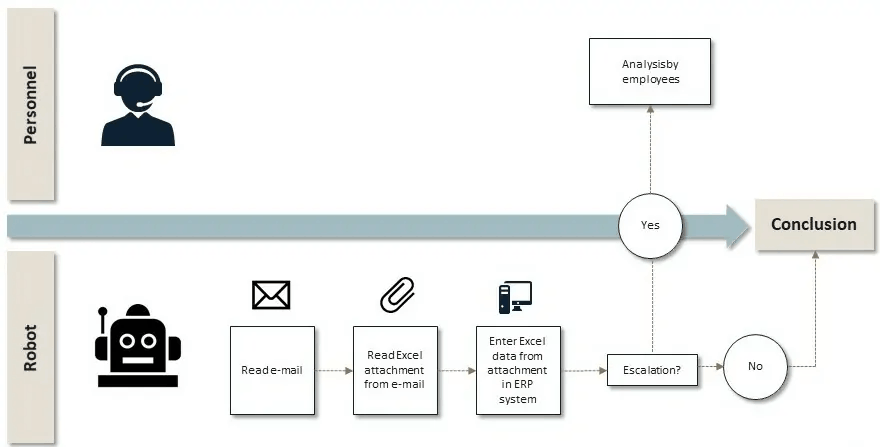
Robotic Process Automation (RPA) is a technology that uses software robots to automate repetitive, rule-based tasks across applications and business systems.
Despite the word “robot,” RPA does not typically involve physical machines. Instead, an RPA bot is a software program designed to interact with digital systems much like a human user. It can open applications, read and transfer information, fill out forms, move files, update records, and trigger predefined actions automatically.
RPA is particularly effective for processes that have:
For example, consider a company that receives hundreds of invoices every week. An RPA bot can collect invoice information from a predefined source, enter the relevant details into an ERP system, validate specific fields, and route the invoice according to predefined business rules.
The important point is that the bot does not need to determine what the business wants or make complex judgments. The process and decision rules have already been defined by the organization, and the bot simply executes them consistently.
This predictability is one of RPA's biggest strengths. Because RPA bots follow predefined instructions, they can perform high-volume operational tasks quickly and consistently while reducing the amount of manual effort required from employees.
Common RPA Use Cases
RPA can be applied across many business functions where repetitive digital tasks follow a consistent process. Common use cases include:
Data entry and data transfer between applications
Invoice processing and accounts payable workflows
Report generation and scheduled reporting
Employee onboarding and administrative workflows
System-to-system data movement
Order processing and status updates
File and document handling
Scheduled administrative tasks
Reconciliation and verification processes
The underlying principle is simple:
If a process can be clearly defined as “when X happens, do Y,” RPA may be a strong candidate for automation.
However, RPA is most effective when the process is stable and follows clear rules. When a task requires understanding unstructured information, interpreting context, making decisions, or adapting to changing situations, technologies such as AI and AI agents may be better suited.
This distinction is important when comparing traditional RPA with modern AI-powered automation.
What Are AI Agents?
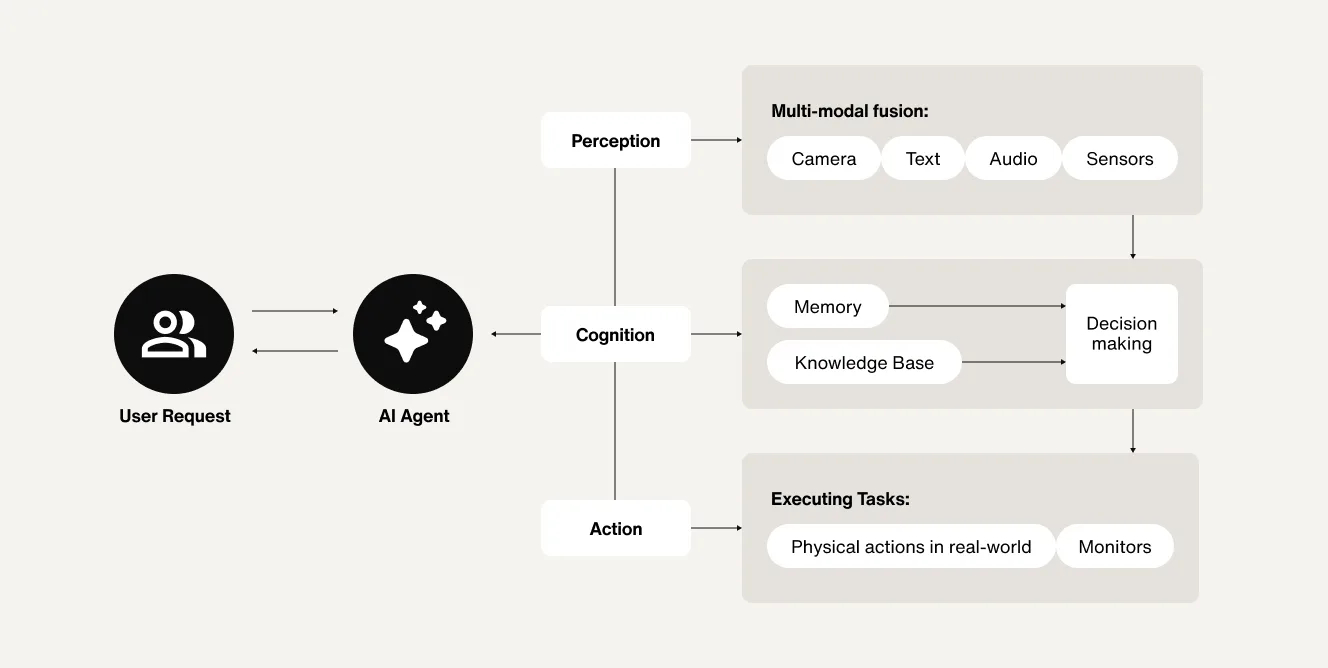
AI agents are software systems designed to pursue goals with a degree of autonomy.
Instead of requiring every step to be explicitly programmed, an AI agent can interpret a goal, analyze available information, decide what actions are appropriate, use connected tools or systems, and adjust its approach based on what it encounters.
Modern AI agents commonly use technologies such as large language models (LLMs), external tools, APIs, memory, retrieval systems, and orchestration frameworks.
For example, instead of creating a fixed workflow for handling customer complaints, a business could give an AI agent a goal:
"Review incoming customer complaints, understand the issue, check the customer's history, determine the appropriate response, and escalate cases that require human attention."
The agent may need to determine which information is relevant, which system to query, whether the issue can be resolved automatically, and when a human should become involved.
This makes AI agents particularly useful for workflows involving:
AI agents are therefore less about repeating a fixed sequence and more about reasoning and acting within a defined objective.
AI Agents vs. RPA: Side-by-Side Comparison
Although both RPA and AI agents are used to automate business processes, they approach automation differently. RPA is designed to execute predefined instructions consistently, making it ideal for repetitive and predictable tasks. AI agents, on the other hand, are designed to work toward a goal by interpreting information, making context-based decisions, and adapting their actions when circumstances change.
The table below highlights the key differences between the two approaches:
| Factor | RPA | AI Agents |
|---|
| Primary focus | Automating repetitive tasks | Achieving goals through adaptive actions |
| Decision-making | Follows predefined rules | Uses context and reasoning |
| Input type | Mostly structured data | Structured and unstructured data |
| Workflow | Fixed and predefined | Dynamic and adaptable |
| Adaptability | Limited | High |
| Best suited for | Repetitive, predictable processes | Complex, variable workflows |
| Human involvement | Usually defined by workflow | Can involve humans when needed |
| Execution | Deterministic | Probabilistic and context-dependent |
| Exception handling | Requires predefined rules | Can interpret a wider range of exceptions |
In simple terms, RPA is best when you already know the steps and want them executed consistently. AI agents are more useful when the goal is clear but the exact steps may need to change depending on the situation.
This distinction becomes especially important when businesses decide which type of automation is appropriate for a particular process or whether combining both technologies would deliver better results.
Conclusion
RPA and AI agents both play an important role in modern business automation, but they solve different types of problems. RPA is best suited for structured, repetitive, and rule-based processes where the steps are clearly defined and consistency is the priority. AI agents are better suited to dynamic workflows that require interpretation, context, decision-making, and the ability to adapt to changing situations.
The choice between the two should therefore depend on the nature of the process rather than simply choosing the newer technology. Businesses with stable, predictable workflows can benefit significantly from RPA, while processes involving unstructured information and variable decisions may benefit more from AI agents.
In many cases, the most effective approach may be to combine both technologies. An AI agent can interpret information, make decisions, and determine what needs to happen, while RPA can execute repetitive actions across existing business applications.
Ultimately, the goal is not to replace one technology with another, but to use the right level of automation for the right business process. By understanding the strengths and limitations of RPA and AI agents, organizations can build automation strategies that improve efficiency, scalability, consistency, and overall business performance.