Introduction
Framing this as "Next.js vs. React" suggests a binary choice, but that’s slightly misleading. Next.js is built on top of React, so the real question isn’t React or Next.js , it’s whether, where, and to what extent your application benefits from server-side rendering (SSR) instead of client-side rendering (CSR).
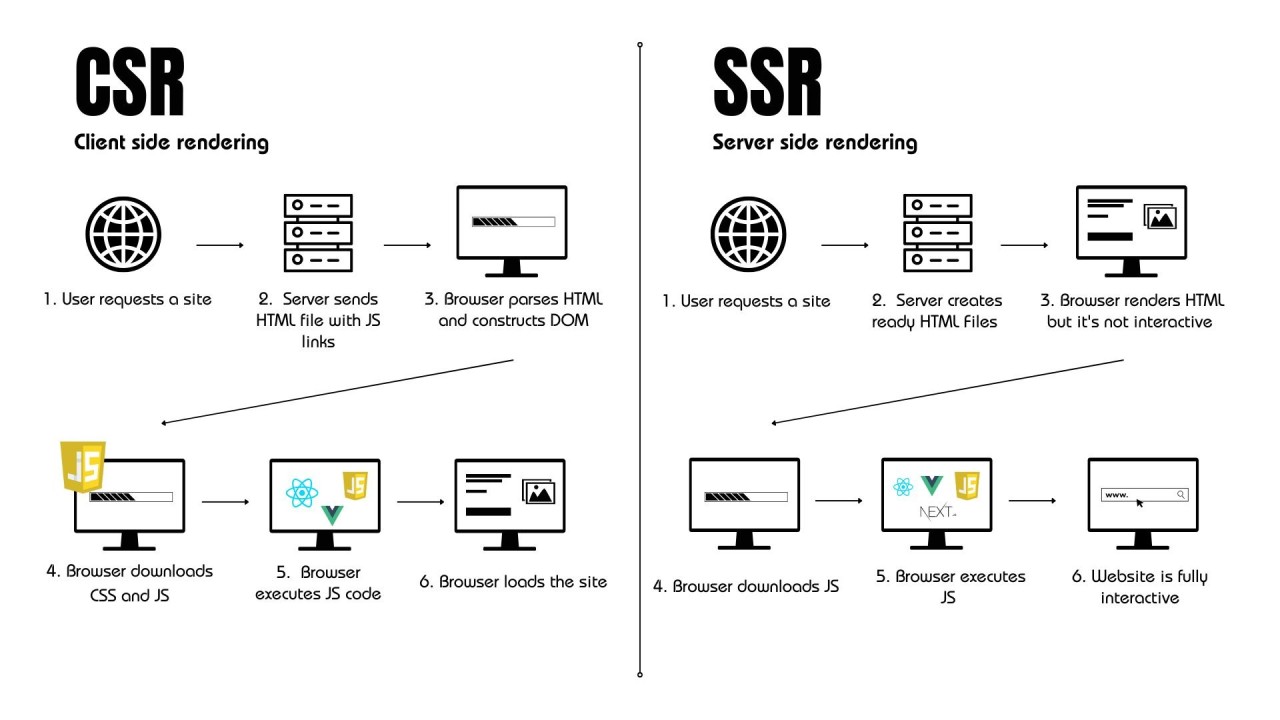
A standard React application typically renders in the browser: the server sends a mostly empty HTML shell, JavaScript is downloaded, and React builds the interface on the client side. Next.js expands on this model by introducing multiple rendering strategies, including SSR, static generation, and streaming, allowing content to be delivered as fully formed HTML before JavaScript executes.
As of 2025–2026, this decision has become even more nuanced. Modern Next.js increasingly shifts rendering choices from the page level to the component level, enabling developers to decide exactly which parts of an application should render on the server and which should remain client-side. Because of this flexibility, understanding when SSR delivers real benefits — and when it simply adds unnecessary complexity is more important than ever.
What Client-Side Rendering (CSR) Actually Does
In plain React (a classic single-page application), the browser requests a page and receives back a near-empty HTML file plus large JavaScript bundles. The browser downloads and executes that JavaScript, React renders the UI, fetches any needed data via API calls, and only then does the page become visible and interactive. This produces a real, noticeable delay before content appears but it also means simpler server setup (often just static file hosting) and rich, app-like interactivity once the app has loaded.
What Server-Side Rendering (SSR) Actually Does
With SSR, the server running Node.js renders the React components into a complete HTML page before sending anything to the browser. The user receives a fully-formed page immediately, and JavaScript then "hydrates" it afterward to make it interactive. Next.js 15 pushes this further using React's streaming and concurrent features to progressively stream HTML to the browser, improving Time-to-First-Byte and giving users visible content even faster than traditional SSR alone.
Side-by-Side: CSR vs. SSR
| Factor | Client-Side Rendering (CSR) | Server-Side Rendering (SSR) |
|---|
| Where Rendering Happens | In the browser, after JS loads | On the server, before the page is sent |
| Initial Load Speed | Slower - blank shell until JS executes | Faster - visible content on first response |
| SEO | Poor by default - crawlers must execute JS first | Excellent - crawlers receive fully-rendered HTML |
| Interactivity After Load | Rich, app-like, no reload needed | Requires hydration before becoming interactive |
| Server Load | Low - often just static file hosting | Higher - server renders HTML on every request |
| Best For | Dashboards, internal tools, highly interactive apps | Public-facing pages, content sites, e-commerce |
| Data Fetching Pattern | Often sequential (render → fetch → render again) | Can fetch multiple data sources in parallel server-side |
When You Actually Need SSR
SSR earns its added server complexity in a few specific, well-defined situations:
SEO genuinely matters. Search crawlers operate under tight crawl budgets when Googlebot hits a CSR app, it has to download JavaScript, execute it, wait for data fetching, and then render content, which is slower and less reliable than receiving pre-rendered HTML directly. If a page needs to rank in search, SSR (or static generation) removes that dependency entirely.
Fast initial load and Core Web Vitals matter for the business. SSR directly improves Largest Contentful Paint (LCP) and Time-to-First-Byte, since the browser receives visible content immediately rather than waiting for a full JavaScript round-trip.
Content is dynamic or personalized but still needs to be crawlable. SSR is a strong middle ground for content that updates frequently (pricing pages, personalized landing pages) but still needs to rank well in search — a case where pure static generation isn't flexible enough.
You're building e-commerce, marketing sites, or content-heavy platforms. These use cases show up consistently across current guidance as the clearest SSR (or SSG) candidates, since discoverability and load speed both directly affect conversion.
When Plain React (CSR) Is Still the Right Call
SSR isn't universally better it adds real server complexity that isn't worth paying for in every case:
Highly interactive, authenticated apps where SEO doesn't matter. An internal admin dashboard, for example, doesn't need to rank in search fast UI updates and rich interactivity after load matter far more than initial paint speed or crawlability.
You want simpler infrastructure. CSR can often run on just static file hosting, avoiding the added server infrastructure SSR requires to render HTML on every request.
The app is behind a login wall. Content that search engines will never see gets no SEO benefit from SSR, making the added rendering complexity a cost without a corresponding payoff.
The Real 2026 Answer: Hybrid Rendering, Not an Either/Or Choice
The most accurate current guidance isn't "pick SSR or CSR" it's that Next.js explicitly enables combining both in the same application: SSR for initial page loads and critical, SEO-relevant content, CSR for highly interactive sections nested within those same pages. Industry analysis anticipates this hybrid approach will dominate going forward, with a majority of React applications expected to use some form of mixed rendering strategy rather than committing to one approach app-wide. A commonly recommended practical pattern:
Default to SSR for most public-facing pages
Use CSR for highly interactive sections nested inside those pages
Use static generation wherever content doesn't change per-request, since it's the fastest option available
Layer in incremental static regeneration (ISR) for content that updates occasionally but doesn't need to be rendered fresh on every single request
React Server Components (RSC) push this even further rather than choosing a rendering mode for an entire page, individual components can each decide how they render, giving far more granular control than the old page-level SSR-vs-CSR choice ever allowed.
Decision Framework
A simple set of questions to work through:
Does this page need to rank in search? If yes, lean SSR or static generation. If it's behind a login wall, SEO isn't a factor at all.
Does initial load speed meaningfully affect conversion or user experience? Landing pages and e-commerce product pages: yes. Internal dashboards: usually no.
Is the content the same for every visitor, or does it change per-request? Same for everyone → static generation. Changes per-request but still needs to be crawlable → SSR. Highly personalized and not SEO-relevant → CSR is often simpler.
Can this decision be made at the component level instead of the whole page? With React Server Components, it often can — meaning the old "pick one for the whole app" framing is increasingly outdated advice.
Conclusion
"Next.js vs. React" was never really a competition Next.js is React with server-side rendering (and several other rendering modes) layered on top, and the actual decision worth making is when SSR earns its added complexity versus when plain client-side rendering is genuinely simpler and sufficient. SSR wins clearly for SEO-dependent, public-facing, content-heavy pages where initial load speed affects the business outcome. CSR still wins for highly interactive, authenticated tools where search visibility was never going to matter. And increasingly, the real 2026 answer isn't choosing one for your whole application it's mixing both, often at the individual component level, and letting each part of your app render the way that actually fits its job.