Introduction
Most in-house vs. outsourcing comparisons stop at a simple salary-versus-day-rate calculation. That approach misses the real costs and can lead to expensive hiring and delivery decisions.
A senior developer’s salary is only one part of the true cost of an in-house hire. Employer taxes, benefits, recruitment, equipment, management overhead, and the productivity gap during onboarding can significantly increase the total investment.
Outsourcing has costs too. Ramp-up time, communication, coordination, and contract management all need to be considered when evaluating the actual value of an external team.
This guide provides a more complete comparison of the total cost of ownership, delivery speed, flexibility, and operational risk of building an in-house team versus outsourcing to a proven team like Levrez. The goal is simple: make the decision based on the full picture not a headline salary or day rate.
The True Cost of an In-House Development Team
The number most companies compare against an outsourcing quote is a developer’s base salary—but that’s not the true cost of an in-house hire.
A useful rule of thumb is to multiply a developer’s salary by roughly 1.75–1.85× to estimate the fully loaded annual cost once the major hidden expenses are included.
These costs typically include:
Employer taxes, benefits, and pension contributions - often adding another 20–40% on top of gross salary.
Recruitment costs - including agency fees, recruiter salaries, interview time, and internal hiring effort.
Onboarding and ramp-up time - new hires can take 3–6 months to reach full productivity while receiving their full compensation.
Turnover and replacement costs - when developers leave, replacing them can cost roughly 50–200% of their annual salary when recruitment, onboarding, and lost productivity are considered.
Equipment, software, and office overhead - laptops, development tools, licenses, workspace, and other expenses that increase with headcount.
For a small in-house development team, these additional costs can push the fully loaded annual cost per developer into the $200,000–$300,000+ range, depending on location, seniority, benefits, and operating model.
The key takeaway: salary is only the starting point. A meaningful comparison should look at the total cost of employing and operating the team-not just the number on the offer letter.
The True Cost and Speed of Outsourcing
Outsourced day rates look expensive in isolation, but the comparison changes once ramp-up time and risk transfer are factored in properly:
Faster start. A reputable outsourcing partner can typically have a team ramping on your project within 2–4 weeks compared to 3–6 months for an in-house team to hire and reach full productivity.
No recruiting or turnover risk on your side. If a developer on an outsourced team leaves, the vendor replaces them without you having to run a new hiring cycle a real, measurable risk transfer that in-house teams don't get.
Regional rate advantage. A senior developer in the US typically runs $100–150/hour, while an equivalent skill level through an outsourced team in a region like India commonly runs $25–50/hour , a gap that widens further once fully-loaded in-house costs are included.
Real overhead still exists. Ramp-up time to learn your codebase and domain, management and communication overhead on your side, and contract/IP protection review are genuine costs outsourcing isn't free of overhead, just a different shape of it.
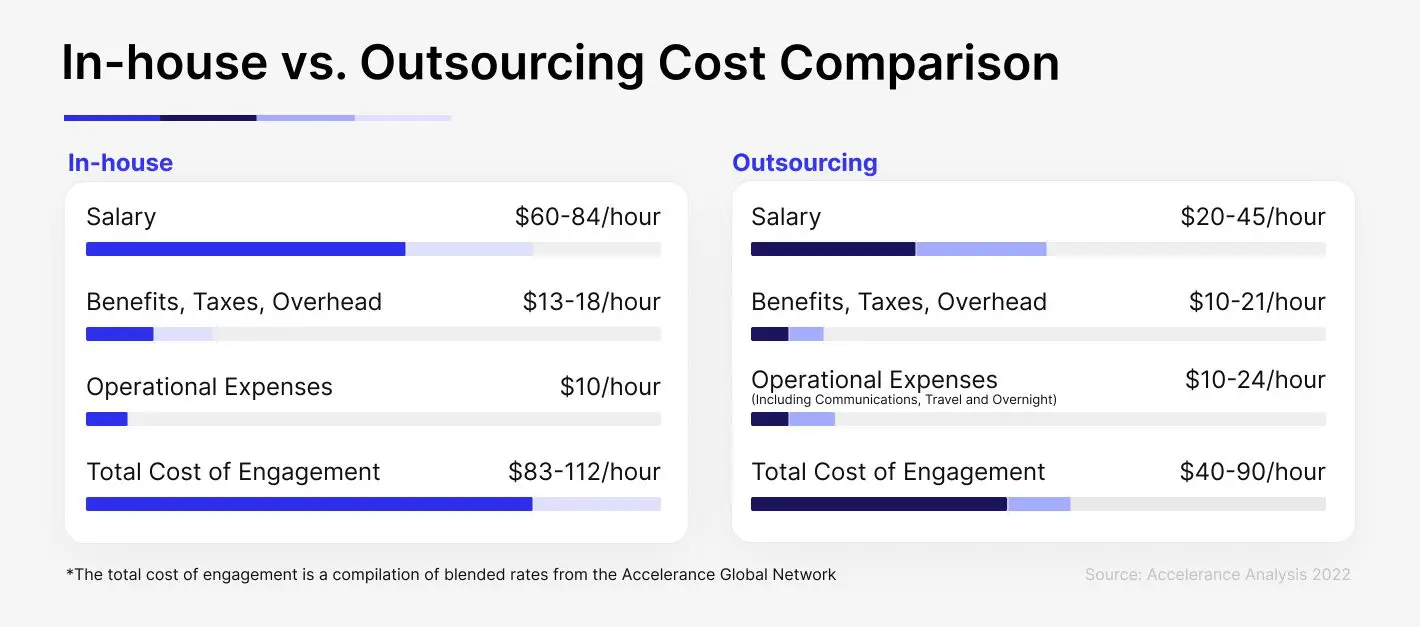
Side-by-Side: Cost and Speed Compared
| Factor | In-House Team | Outsourcing (e.g., Levrez) |
|---|
| Time to Start | 30–90 days to hire, then 3–6 months to full productivity | Typically 2–4 weeks to a fully ramped team |
| Fully-Loaded Annual Cost per Developer | Commonly $200K–$300K+ (salary × ~1.75–1.85) | Significantly lower, often 40–70% less total cost for equivalent output |
| Turnover Risk | Borne by you, average tenure under 3 years, replacement costs 50–200% of salary | Transferred to the vendor — team continuity maintained without your hiring cycle |
| Scaling Up | Requires a new hiring cycle each time | Can typically scale within days to weeks |
| Scaling Down | Layoffs, notice periods, HR complexity | Contract flexibility, capacity adjusts without employment law overhead |
| Access to Specialized Skills | Limited to what you can hire locally, in a market with an estimated 4 million unfilled developer roles | Immediate access to a multidisciplinary team already assembled |
| Best Fit | Software is your core, long-term competitive advantage, well-funded, 10+ year horizon | Time-bound projects, capital-constrained teams, or specialized skill needs outside your core in-house strength |
Why Speed Matters as Much as Cost
The real cost of a bad decision here usually isn't the money, it's the time lost. A bad in-house hire can cost upward of $200,000 and three months of hiring cycles to recover from; a bad outsourcing engagement can cost six to twelve months of rework if the wrong partner is chosen. That's why speed and vendor quality both matter as much as the headline rate, a faster, well-vetted outsourced team compresses your time-to-market in a way pure cost comparison doesn't capture, but only if the delivery quality is actually there.
When In-House Still Makes Sense
Outsourcing isn't universally the better choice, it depends on what the software actually is to your business:
Your software is the core product, not a supporting tool, if engineering is your primary competitive advantage, long-term in-house ownership of architecture and institutional knowledge matters more than short-term cost savings.
You're well-funded with a long runway and building toward a 10+ year product vision, where the upfront investment in a permanent team pays off over a much longer horizon.
Deep architectural and security decisions need to stay fully in-house for compliance, IP, or strategic control reasons.
When Outsourcing to Levrez Makes More Sense
You need to move fast, a product launch, MVP, or competitive deadline where a 3–6 month in-house ramp simply isn't an option.
You need specialized skills you can't hire locally, access to a multidisciplinary team (backend, frontend, mobile, cloud, QA) without expanding permanent headcount for each specialty.
You're capital-constrained or pre-revenue, and need to extend runway without carrying the fixed cost of a full in-house team.
You want risk transferred, not carried, turnover, recruiting, and ramp-up risk sit with the vendor rather than landing back on your team every time someone leaves.
A Practical Middle Path: The Hybrid Model
For many companies, the strongest cost-to-output ratio doesn't come from choosing one model exclusively, it comes from a hybrid approach: keeping product strategy, architecture, and core security decisions in-house, while outsourcing execution, scaling, and specialized technical work to a partner like Levrez. This keeps strategic control where it matters most while still getting the speed and cost advantages of an established team for the execution-heavy work.
Conclusion
The in-house vs. outsourcing decision isn't really a cost debate, it's a total-cost-of-ownership and speed debate, and the headline numbers on both sides hide more than they reveal.
In-house development offers direct control and long-term institutional knowledge, but comes with a 3-6 month ramp and a fully-loaded cost that routinely runs 1.75-1.85x the visible salary. Outsourcing to an established team like Levrez compresses that timeline to weeks, transfers turnover and recruiting risk away from you, and typically costs 40-70% less for equivalent output, provided the partner is genuinely well-vetted. For most companies outside of a small set of core-product, well-funded scenarios, that combination of speed and total cost makes outsourcing the more practical starting point, often blended with in-house ownership of the strategic pieces that matter most.
Ready to see how fast your project could actually move? Talk to Levrez about deploying a dedicated development team in weeks, not months.