Introduction
The build-vs-buy decision looks deceptively simple on paper: a SaaS subscription may cost $50–$500 per month, while a custom solution can start at $35,000 and scale significantly from there. At first glance, the subscription seems like the obvious choice. But comparing only the initial invoice overlooks the full cost of ownership.
Off-the-shelf SaaS can accumulate significant hidden costs over time through per-seat pricing, usage-based fees, integrations, premium feature tiers, customization limitations, and vendor dependencies. What starts as an affordable monthly subscription can become a substantial long-term investment as your business grows.
On the other hand, building custom software requires a larger upfront investment but can provide greater control, scalability, and flexibility tailored to your specific requirements.
This guide breaks down the true cost of building vs. buying, examines the long-term trade-offs of each approach, and provides a practical framework to help you determine which option makes the most sense for your business.
What Each Option Actually Means
Off-the-shelf SaaS is a ready-made software product designed to serve multiple businesses, such as Salesforce, HubSpot, Shopify, or QuickBooks. You pay a recurring subscription, configure the available settings, and can typically start using the platform quickly. The trade-off is flexibility: your business processes often need to adapt to the software rather than the software adapting to your exact requirements.
Custom software development is built specifically around an organization’s unique processes, requirements, and goals. You gain greater control over the codebase, features, integrations, and product roadmap, without being constrained by a third-party platform’s limitations or priorities. The trade-off is a higher upfront investment, longer development timeline, and ongoing responsibility for maintenance and improvements.
The Real Cost of Off-the-Shelf SaaS
The subscription price is genuinely the easy part to evaluate it's everything layered on top of it that changes the math:
Per-seat pricing scales fast. Enterprise tools like Salesforce or HubSpot commonly run
$1,200–$3,600 per user, per year, a 50-person team can be paying $60,000–$180,000 annually for a product they still can't fully customize.
Integration costs add up. Connecting off-the-shelf software into your existing stack can cost anywhere from $20,000 to $100,000, compared to integration being built directly into a custom solution from the start.
Prices climb every year. SaaS vendors commonly raise prices 5–15% annually, while a custom solution's ongoing cost is far more predictable and within your control.
You often pay for features you don't use. One real-world example: a company paying $96,000 a year for a SaaS order-management platform found 40% of its features sat completely unused, while a business-critical custom workflow the company actually needed didn't exist in the system at all.
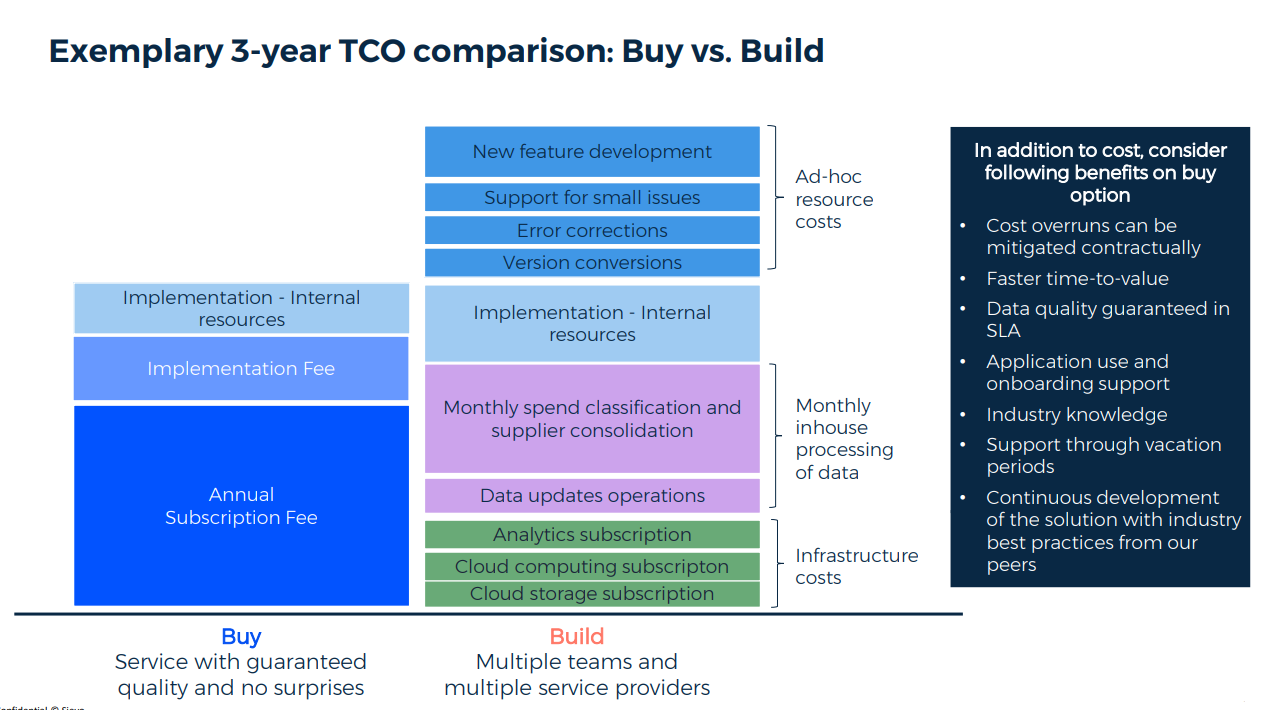
The Real Cost of Custom Software Development
Custom development has become faster and more accessible than the "expensive, slow, risky" reputation it still carries but it's still a real, upfront investment with predictable cost bands:
Discovery and architecture: roughly 2–4 weeks, $15,000–$40,000
Development and testing: roughly 12–24 weeks for core functionality, $80,000–$350,000 depending on complexity
Ongoing maintenance: roughly $2,000–$8,000 per month, or a broader industry rule of thumb of
15–25% of the initial build cost annually
For a well-scoped mid-market application, total first-year cost commonly lands in the $150,000–$400,000 range, a number that sounds large in isolation, but is directly comparable to the true total cost of ownership of an equivalent-scope enterprise SaaS deployment once that platform's hidden costs are included. Where the work is built also matters: European development studios typically bill $50–99/hour for senior work against $150–300/hour at US firms, meaning the same custom build can cost roughly a third to a half as much depending on where the team is based.
Side-by-Side: 5-Year Comparison
| Factor | Off-the-Shelf SaaS | Custom Software |
|---|
| Upfront Cost | Low, $50–500/month to start | High, $35,000–$600,000+ depending on scope |
| Time to Launch | Hours to days | 3–6 months for an MVP; longer for full platforms |
| True 5-Year TCO | Often 2.5x–4x the headline price once scaling, integration, and price hikes are included | Predictable, large upfront cost, but no per-seat scaling or annual price hikes |
| Customization | Limited to vendor's configuration options | Built exactly around your workflows |
| Ownership | You rent access; no code ownership | Full ownership of code, data, and roadmap |
| Vendor Dependency | High, subject to vendor's pricing, roadmap, and continued existence | None, no vendor lock-in |
| Maintenance Burden | Handled by the vendor | Your responsibility (or your dev partner's), 15-25% of build cost annually |
| Best Fit | Standard business processes, fast deployment need, limited budget | Unique processes that are a genuine competitive advantage, longer planning horizon |
When Off-the-Shelf Is the Right Call
Your process isn't a competitive differentiator. If the workflow you're solving for is common across your industry, a mature SaaS product has almost certainly already solved it well.
Speed to market is the priority right now. Most off-the-shelf tools are operational within hours of signup, no development timeline, no architecture planning, no testing phase.
Your budget or timeline can't support a multi-month build. If you're under roughly $50,000 and a 3-month runway, starting with off-the-shelf is the more realistic path.
When Custom Software Is the Right Call
Your process genuinely differentiates you. If a workflow is core to your competitive advantage, adapting it to fit generic software (rather than the other way around) can quietly cost you that advantage.
You're already running significant off-the-shelf spend. If per-seat and integration costs are climbing toward the $150,000–$400,000 range a custom build would cost, and you're locked out of the specific features you actually need, the economics start favoring ownership.
You need full control over data, roadmap, and integrations. No vendor lock-in, no dependency on a third party's pricing decisions or continued existence.
A Simple Decision Framework
Three questions tend to cut through most of the noise in this decision:
Does this business process provide a real competitive advantage? If yes, lean custom. If no, off-the-shelf is usually sufficient.
Can you realistically adapt your process to fit standard software? If yes, off-the-shelf likely works fine. If no, custom is the better fit.
Is your budget over roughly $50,000 and your timeline over 3 months? If yes, custom is genuinely viable. If no, start with off-the-shelf and revisit custom later as you scale.
Conclusion
Off-the-shelf SaaS wins decisively on upfront cost and speed but the true, multi-year cost of ownership is routinely 2.5–4x the sticker price once per-seat scaling, integration costs, and annual price increases are accounted for. Custom software carries a larger, more visible upfront investment, but offers full ownership, no vendor lock-in, and cost predictability that a growing SaaS bill often can't match past the first year or two. The right call isn't about which option is cheaper in isolation, it's about whether the process you're solving for is common enough to buy, or unique enough that owning it is worth the investment.
Not sure whether your use case justifies a custom build? Talk to Levrez about a build-vs-buy cost analysis specific to your business.